
FLAG GUIDE
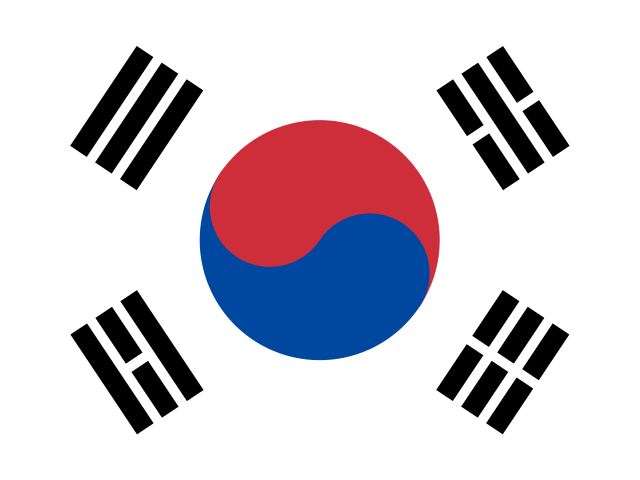
Flag of Republic of Korea
Asia
Flag origins
South Korea’s flag is called the Taegeukgi. It has a white field, a red-and-blue taegeuk in the center, and four different black trigrams in the corners. The Korean government explains white as a traditionally favored color expressing brightness, purity and a peace-loving spirit. The central taegeuk draws on the East Asian concept of yin and yang and represents cosmic harmony. Red stands for yang and blue for yin: opposing forces interacting and balancing one another. The four black trigrams have their own meanings: ☰ geon for heaven, ☷ gon for earth, ☵ gam for water, and ☲ ri for fire. Together, the design expresses a worldview of harmony between opposites: yin and yang, heaven and earth, water and fire. The government describes this as symbolizing the Korean people’s ideal of harmony with the universe.
Flag story
The flag’s origins go back to the Joseon dynasty in 1882, long before the Republic of Korea was established in 1948. As Joseon developed diplomatic relations with Japan and other countries, it needed a national flag. In 1882, a design associated with diplomatic envoy Park Yeong-hyo and others began to be used, and in 1883 it was formally proclaimed the dynasty’s national flag. Early versions differed considerably from today’s taegeuk shape and trigram arrangement. Various designs were subsequently used. After the Republic of Korea was established in 1948, the design was standardized, with specifications underlying the current flag formally adopted in 1949. Before the peninsula was divided into North and South, the Taegeukgi had served as a symbol of Korea as a whole.
Flag features
- Colors
- Red, Blue / light blue, White, Black
- Symbols
- Circle, Trigram, Coat of arms / emblem
- Island country
- No
- Landlocked
- No
Editorial notes and references
Edited by ABELHA WORKS. The English text translates the administrator-edited Japanese description. Legends should be distinguished from documented history. General reference links do not substantiate every statement in the text.
 Afghanistan
 Brunei
 Ecuador
 Egypt