
FLAG GUIDE
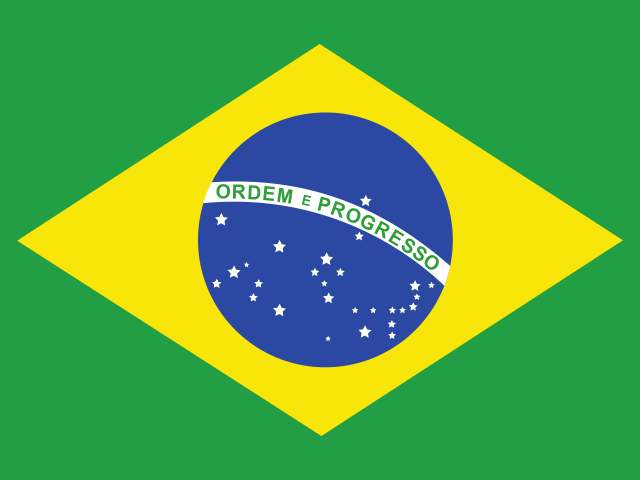
Flag of Brazil
South America
Flag origins
Brazil’s flag has a green field with a yellow diamond, containing a blue celestial sphere with stars and a white band. Its basic design was established on November 19, 1889, shortly after the monarchy ended and Brazil became a republic. Green and yellow were inherited from the Empire: green was associated with Emperor Pedro I’s House of Braganza and yellow with Empress Leopoldina’s House of Habsburg. They are now also linked to forests, mineral resources and national wealth, but their historical origins are dynastic. The blue circle and twenty-seven stars represent the sky over Rio de Janeiro when the republic was proclaimed on November 15, 1889. The stars correspond to the twenty-six states and the Federal District. The law provides for changes to the stars when states are created or abolished. The Portuguese words ORDEM E PROGRESSO on the white band mean “Order and Progress.” They derive from the positivist philosophy of the French thinker Auguste Comte and reflect its influence on those involved in founding the republic.
Flag story
Brazil’s twenty-seven stars are not arranged at random. Legally, the design is modeled on the sky over Rio de Janeiro at 8:30 a.m. on November 15, 1889, viewed as though from outside the celestial sphere rather than from the ground looking upward. This makes the arrangement appear reversed compared with an ordinary view of the sky. The isolated star above the ORDEM E PROGRESSO band is neither a mistake nor decoration. It is Spica, in the constellation Virgo, representing the northern state of Pará. The flag thus recreates the sky associated with the republic’s founding day, with each of its twenty-seven stars assigned to a particular state or the Federal District — an unusually astronomical national flag.
Flag features
- Colors
- Green, Yellow / gold, Blue / light blue, White
- Symbols
- Diamond, Circle, Star, Lettering, Diagonal lines / bands, Triangle
- Island country
- No
- Landlocked
- No
Editorial notes and references
Edited by ABELHA WORKS. The English text translates the administrator-edited Japanese description. Legends should be distinguished from documented history. General reference links do not substantiate every statement in the text.
 Namibia
 Ethiopia
 Dominica
 Philippines