
FLAG GUIDE
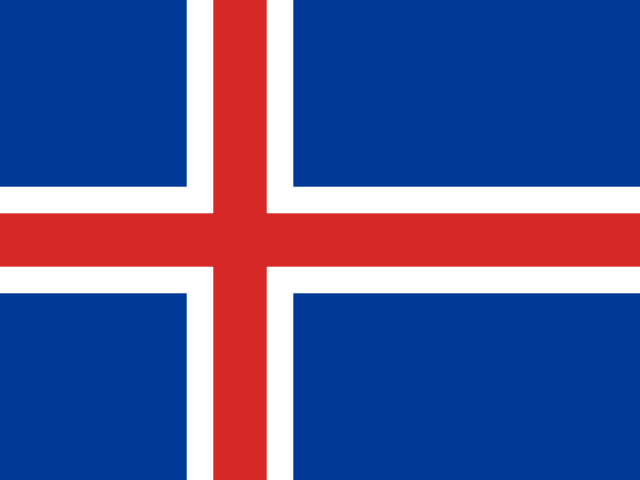
Flag of Iceland
Europe
Flag origins
Iceland’s flag has a red cross within a white Nordic cross on blue. Flag law describes the colors as sky blue, snow white and fire red. Matthías Þórðarson, who proposed the design in 1906, explained blue as the mountains, white as ice and snow, and red as fire: a picture of a land of volcanoes and glaciers. The Nordic cross connects it with Denmark, Norway, Sweden and Finland. A blue-white-red flag was formally recognized in 1915 and became a state symbol when Iceland became sovereign in personal union with Denmark in 1918. The present flag law was enacted at the republic’s foundation on June 17, 1944.
Flag story
An earlier popular proposal was simply a white cross on blue. Denmark’s King Christian X rejected it as too similar to Greece’s flag; concern also arose about confusion with Sweden’s blue-and-yellow flag in poor visibility at sea. Adding a red cross within the white produced the modern design. In 1913, a Danish warship confiscated a blue-and-white flag flown during a boating event in Reykjavík harbor. The incident caused controversy and strengthened the movement for an Icelandic flag.
Flag features
- Colors
- Blue / light blue, Red, White
- Symbols
- Cross
- Island country
- Yes
- Landlocked
- No
Editorial notes and references
Edited by ABELHA WORKS. The English text translates the administrator-edited Japanese description. Legends should be distinguished from documented history. General reference links do not substantiate every statement in the text.
 United Kingdom
 Norway
 Australia
 Cook Islands