
FLAG GUIDE
Flag of India
Asia
Flag origins
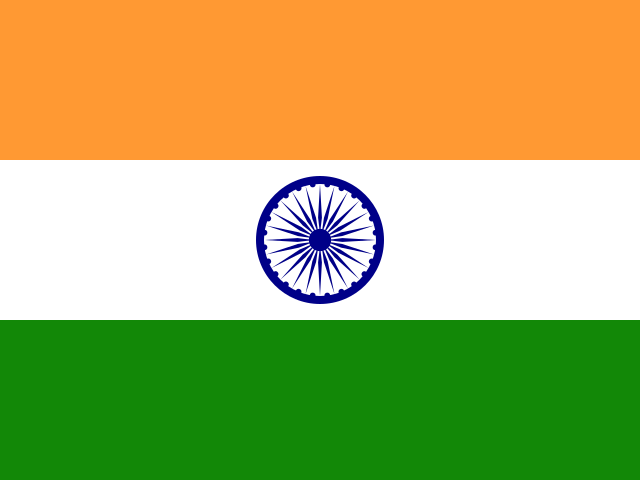
India’s flag has saffron-white-green horizontal bands with a navy-blue Ashoka Chakra, a wheel with twenty-four spokes, at the center. The Constituent Assembly adopted it on July 22, 1947, shortly before independence. At adoption, Sarvepalli Radhakrishnan, later the first vice-president, associated saffron with selflessness and renunciation, white with light and the path to truth, and green with the land and plant life. The wheel derives from Ashoka’s lion capital at Sarnath. It was explained as representing law and justice, movement and progress.
Flag story
Before the present wheel, independence flags used a charkha, or spinning wheel. Gandhi promoted spinning and making Indian cloth to reduce dependence on British goods, making the charkha a movement symbol. In 1921, Pingali Venkayya presented a proposal to Gandhi. A white band and spinning wheel were added following his advice. Saffron-white-green with the charkha subsequently became widespread. In 1947, the wheel’s thread and spindle posed difficulties, including reversal when viewed from the back. Nehru and others retained the idea of a wheel but substituted Ashoka’s Dharma Chakra. Nehru explained that this preserved the spinning-wheel tradition while linking it with ancient Indian culture.
Flag features
- Colors
- Orange, White, Green, Blue / light blue
- Symbols
- Circle, Horizontal stripes, Coat of arms / emblem
- Island country
- No
- Landlocked
- No
Editorial notes and references
Edited by ABELHA WORKS. The English text translates the administrator-edited Japanese description. Legends should be distinguished from documented history. General reference links do not substantiate every statement in the text.
 Iraq
 Iran
 Tajikistan
 Croatia