
FLAG GUIDE
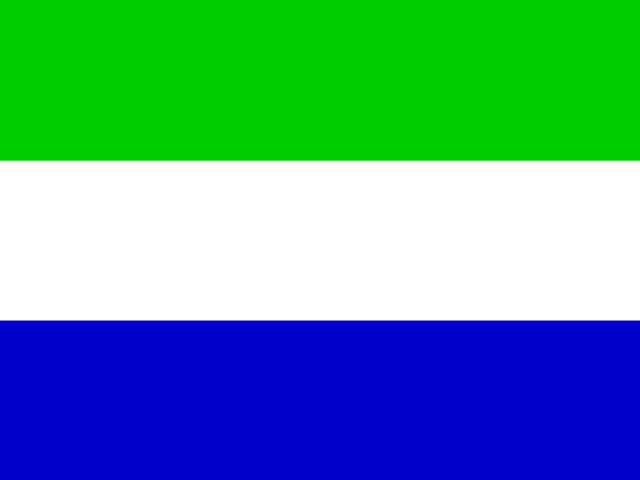
Flag of Sierra Leone
Africa
Flag origins
Sierra Leone’s flag has a simple design of three horizontal bands: green at the top, white in the middle and blue at the bottom. The Constitution explicitly specifies the colors and their order. Government educational materials explain green as agriculture and natural resources, white as peace, unity and justice, and blue as natural harbors and water. The current flag was adopted on April 27, 1961, when Sierra Leone became independent from Britain. The country became a republic ten years later, in 1971, but retained the same flag.
Flag story
Sierra Leone’s capital, Freetown, literally means a town of freedom. From the late eighteenth century, formerly enslaved people and Black settlers arrived in the area from Britain and elsewhere, giving rise to the name. Further arrivals from North America and the Caribbean contributed to a distinctive Creole society. Freetown’s large natural harbor also connects with the blue in the flag. Sierra Leone’s Ministry of Tourism and Cultural Affairs describes the coastal area around Freetown as having one of the world’s largest natural harbors. The blue thus represents more than the sea in general: it is associated with a harbor that played a major role in the nation’s history and development.
Flag features
- Colors
- White, Blue / light blue, Green
- Symbols
- Horizontal stripes
- Island country
- No
- Landlocked
- No
Editorial notes and references
Edited by ABELHA WORKS. The English text translates the administrator-edited Japanese description. Legends should be distinguished from documented history. General reference links do not substantiate every statement in the text.
 Comoros
 Lesotho
 Equatorial Guinea
 Central African Republic