
FLAG GUIDE
Flag of Japan
Asia
Flag origins
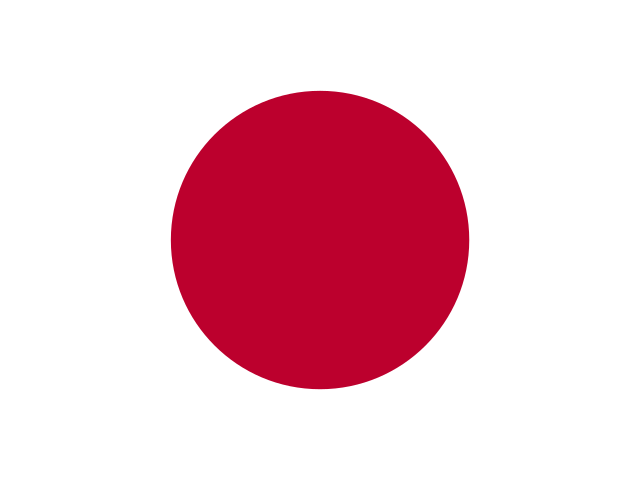
Japan’s national flag is officially called the Nisshōki and is commonly known as the Hinomaru. Its simple design places a crimson disc, representing the sun, at the center of a white field. The current Act on the National Flag and Anthem specifies a height-to-width ratio of 2:3, a disc diameter equal to three-fifths of the flag’s height, and a disc centered on the flag. The sun motif has a long history in Japan, although the government states that the precise origin of the Hinomaru is unclear. Examples predate the Edo period. In 1854, the Tokugawa shogunate adopted the red sun on white as a common identifying flag for Japanese ships. In 1870, the Meiji government issued a proclamation specifying the design of the national flag to be flown by merchant ships.
Flag story
Surprisingly, the Hinomaru was explicitly designated Japan’s national flag by statute only in 1999. It had, of course, already become firmly established as Japan’s de facto flag at home and abroad. Strictly speaking, the 1870 rules defined a flag for merchant ships rather than a general law establishing the national flag. Before 1999, the government described its status as having been established through long-standing practice. The Act on the National Flag and Anthem took effect on August 13, 1999, expressly providing: “The national flag shall be the Nisshōki.” There is also a small design detail: the disc was not always perfectly centered. Under the 1870 merchant-shipping rules, its center was shifted toward the flagpole by one-hundredth of the flag’s width. The 1999 law placed it at the exact center.
Flag features
- Colors
- Red, White
- Symbols
- Circle
- Island country
- Yes
- Landlocked
- No
Editorial notes and references
Edited by ABELHA WORKS. The English text translates the administrator-edited Japanese description. Legends should be distinguished from documented history. General reference links do not substantiate every statement in the text.
 Republic of Korea
 Dominica
 India
 United Arab Emirates