
FLAG GUIDE
Flag of Spain
Europe
Flag origins
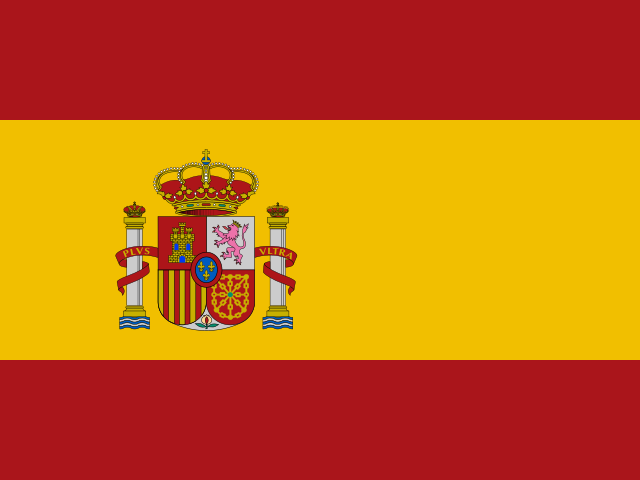
Spain’s flag has red-yellow-red horizontal bands, with yellow twice as wide as either red band. Its basic design originated in 1785 under Charles III as a naval flag readily distinguishable at sea. Current specifications are set out in instruments including the 1978 Constitution. The arms represent historic kingdoms: a castle for Castile, lion for León, red-and-yellow stripes for Aragon, chains for Navarre and pomegranate for Granada. The small central shield bears the arms of the present royal House of Bourbon-Anjou.
Flag story
The two columns flanking the arms are the Pillars of Hercules, representing the sides of the Strait of Gibraltar. In ancient European imagination, the sea beyond was an unknown world associated with Non Plus Ultra, nothing further beyond. During the age of Atlantic exploration, Spain reversed that idea into PLUS ULTRA, further beyond. The pillars and motto entered the arms under Charles I and remain today. Looking closely at the flag reveals a phrase associated with the exploratory ambitions of the era after Columbus.
Flag features
- Colors
- Red, Yellow / gold, Blue / light blue, Green, White
- Symbols
- Horizontal stripes, Coat of arms / emblem, Weapons / tools, Lettering, Plants / flowers, Animal
- Island country
- No
- Landlocked
- No
Editorial notes and references
Edited by ABELHA WORKS. The English text translates the administrator-edited Japanese description. Legends should be distinguished from documented history. General reference links do not substantiate every statement in the text.
 Serbia
 Bolivia
 Croatia
 Belize