
FLAG GUIDE
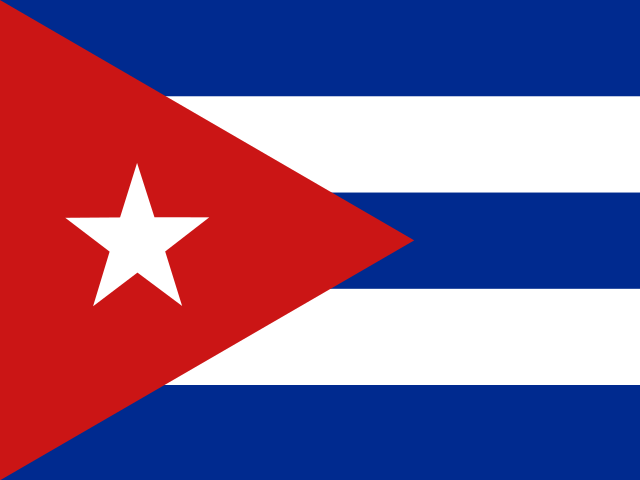
Flag of Cuba
North America
Flag origins
Cuba’s flag has five alternating blue and white horizontal stripes, a red triangle at the hoist and a white five-pointed star. It is also known as La Estrella Solitaria, the Lone Star flag. The three blue stripes represent the island’s former western, central and eastern divisions. The two white stripes represent the purity of Cuban aspirations to independence. The triangle evokes liberty, equality and fraternity, its red the blood shed for independence. The star represents complete freedom and independence.
Flag story
The design originated in New York rather than Cuba. Exiles seeking liberation from Spain, including Narciso López, created it around 1849–1850. López’s expedition flew it after landing at Cárdenas in May 1850. The Library of Congress also holds records of his capture of the town with American volunteers. Puerto Rico later adopted a design based on Cuba’s with red and blue exchanged: Cuba has blue-and-white stripes and a red triangle, Puerto Rico red-and-white stripes and a blue triangle, both with a white star.
Flag features
- Colors
- Blue / light blue, White, Red
- Symbols
- Star, Triangle, Horizontal stripes, Diagonal lines / bands
- Island country
- Yes
- Landlocked
- No
Editorial notes and references
Edited by ABELHA WORKS. The English text translates the administrator-edited Japanese description. Legends should be distinguished from documented history. General reference links do not substantiate every statement in the text.
 Philippines
 United States
 Uzbekistan
 Cape Verde