
FLAG GUIDE
Flag of United States
North America
Flag origins
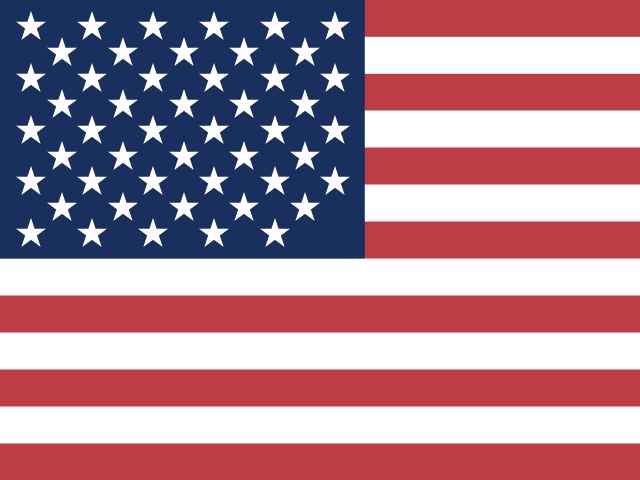
The flag of the United States has thirteen alternating red and white horizontal stripes and fifty white five-pointed stars in a blue canton at the upper left. It is known as the Stars and Stripes. The thirteen stripes represent the original thirteen colonies, while the fifty stars represent the fifty states, one star for each state. On June 14, 1777, the Continental Congress passed its first formal flag resolution, specifying thirteen red and white stripes and thirteen white stars on blue. It did not prescribe the arrangement of the stars, so early flags used various layouts, including circular arrangements. Stars were added as new states joined. Alaska and Hawaii became states in 1959, bringing the total to fifty. The current fifty-star flag has been used since July 4, 1960.
Flag story
The present arrangement of fifty stars was devised by Robert G. Heft while he was a high-school student. In the 1950s, Heft made a fifty-star flag as a school assignment, anticipating statehood for Alaska and Hawaii. His arrangement was later adopted for the official fifty-star flag. The Smithsonian also describes the current star arrangement as a design Heft created for a high-school project. Another interesting detail is that the original 1777 resolution did not say how the stars should be arranged. Detailed official specifications for the layout and proportions came only in 1912.
Flag features
- Colors
- Red, White, Blue / light blue
- Symbols
- Star, Horizontal stripes
- Island country
- No
- Landlocked
- No
Editorial notes and references
Edited by ABELHA WORKS. The English text translates the administrator-edited Japanese description. Legends should be distinguished from documented history. General reference links do not substantiate every statement in the text.
 Cuba
 Uzbekistan
 Cape Verde
 Comoros